Ledger Setup
Part of Chart of accounts and accounting setup
Separating tracking categories from general ledger accounts
Decide when a transaction needs a separate ledger account and when a tracking label or cost centre answers the reporting question.
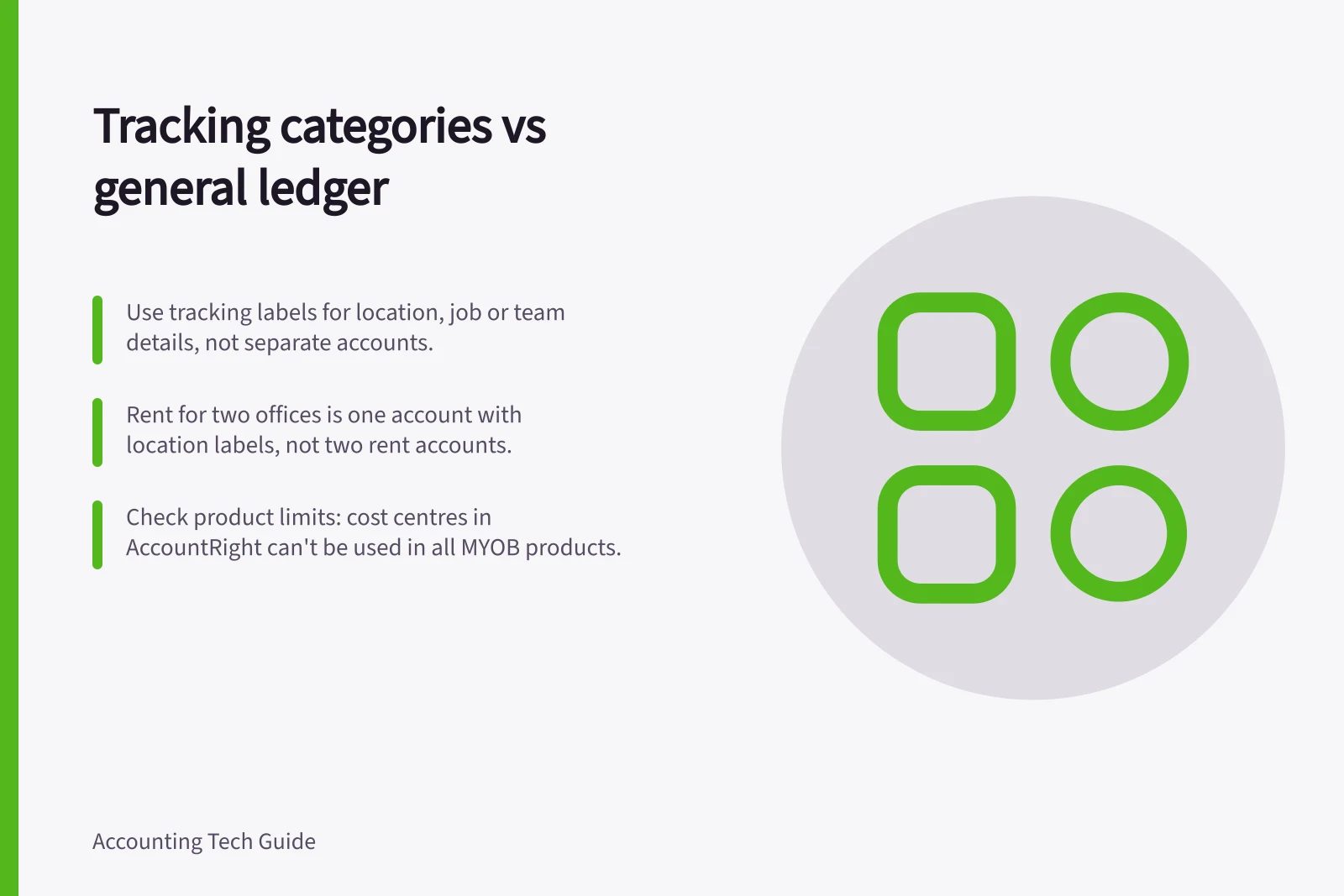
Use a general ledger account to record what a transaction is. Use a tracking category, cost centre or similar label to analyse which part of the business it relates to, if the product supports that feature. Rent for two offices is still rent; separate office labels may provide the location breakdown without two rent accounts.
Pros and cons of using tracking categories vs. separate ledger accounts
- Pros of tracking categoriesSimpler setup; avoids cluttering the general ledger; enables flexible reporting by location, job or team; useful for shared costs with defined allocation methods.
- Cons of tracking categoriesMay not support reconciliation to full financial statements; limited to software that supports them; inconsistent application risks data quality.
- Pros of separate ledger accountsFull financial statement clarity; supports direct reconciliation; required for items like loans or separately managed bank accounts.
- Cons of separate ledger accountsCan lead to account proliferation; harder to manage if many similar transactions need separation; may reduce reporting flexibility.
Choose the right kind of detail
Ask whether the amount needs a different financial statement account regardless of office, job or team. A separately reconciled bank balance or a loan liability needs an appropriate ledger account. If the difference is only which location incurred an otherwise similar expense, a tracking label may be more useful.
Reporting question / Likely choice
- Which bank balance is being reconciled?
- A distinct ledger account.
- Is this a loan or an operating expense?
- The appropriate liability or expense account.
- Which office incurred the rent?
- A location label, where supported.
- Which job used the materials?
- A suitable job or project dimension, where supported.
Check the product's vocabulary and limits
Category does not mean the same thing in every interface. MYOB Business calls general ledger accounts categories.
AccountRight cost centres label transactions for segment reporting; MYOB says they can only be created or edited in the AccountRight software. Its cost centre reports are available to AccountRight users of that feature, including cost centre balance sheet, general ledger and profit and loss reports.
Before adopting a tracking design, check the intended product and plan. Find out which transactions can carry a label, whether amounts can be split between segments, how unlabelled entries appear, and whether segment totals can be reconciled to whole-business reports.
Do not assume that an AccountRight feature exists in another MYOB product or another provider's software.
Key facts about tracking categories in MYOB Business
- MYOB Business terminology
- General ledger accounts are called 'categories'
- Cost centre creation
- Only possible in AccountRight software
- Report availability
- Cost centre reports available to AccountRight users with the feature enabled
Make labels consistent
Choose values that staff can apply without guessing. Locations such as ‘Melbourne’ and ‘Sydney’ are clearer than undefined labels such as ‘Growth’ and ‘Special’. Define when each label is used, who maintains the list and how shared costs are handled. An approved allocation method may be suitable for some shared costs; others may need to remain unallocated and be explained in the report.
Check sample entries such as a branch sale, shared rent, a refund and a transaction spanning two jobs. Compare segment views with the whole-business report and investigate any difference, including unlabelled entries.