Invoicing
Invoicing and accounts receivable tools
Compare Australian invoicing tools by invoice creation, unpaid balances, reminders, disputes, recurring charges and plan limits.
Choose an invoicing and accounts receivable tool by following a customer charge from invoice to settlement. Check that it produces the right document, keeps unpaid balances visible, supports follow-up and preserves the history of corrections. An invoice template alone cannot show how the team will manage money still owing.
Define the billing path
Identify who confirms the sale, prepares and sends the invoice, records receipts, answers customer queries and reviews overdue balances. Include a partial payment, a disputed charge and a correction. Each needs an owner and a visible outcome.
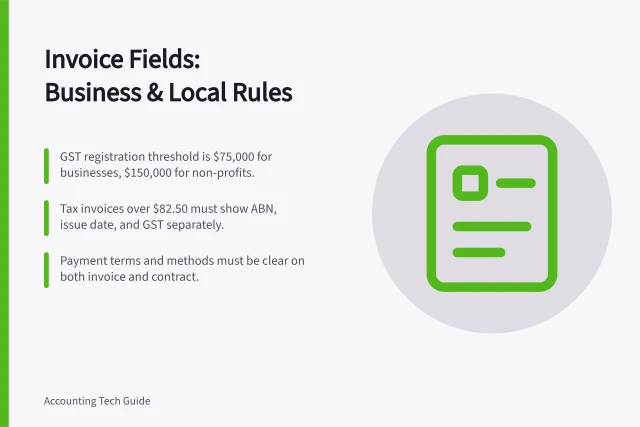
For an Australian business, confirm GST registration and the type of sale before setting the template. Tax invoices need specified seller, date, sale and GST information. A business that is not registered for GST should issue an ordinary invoice without charging GST. Ask an accountant or BAS adviser to review uncertain treatment.
Show the agreed due date and payment method clearly. A purchase order number, job reference or service period may also help a customer approve payment. These customer requirements should agree with the contract or order.
Define the billing path for Australian businesses
- Confirm sale and GST statusCheck if business is GST-registered. Issue tax invoice for taxable sales over $82.50 including GST or upon request.
- Assign ownership for follow-upDesignate staff to manage partial payments, disputes, corrections, and overdue balances.
- Record customer referencesAdd purchase order number, job reference, or service period to help customer approve payment.
Issue the right invoice on time
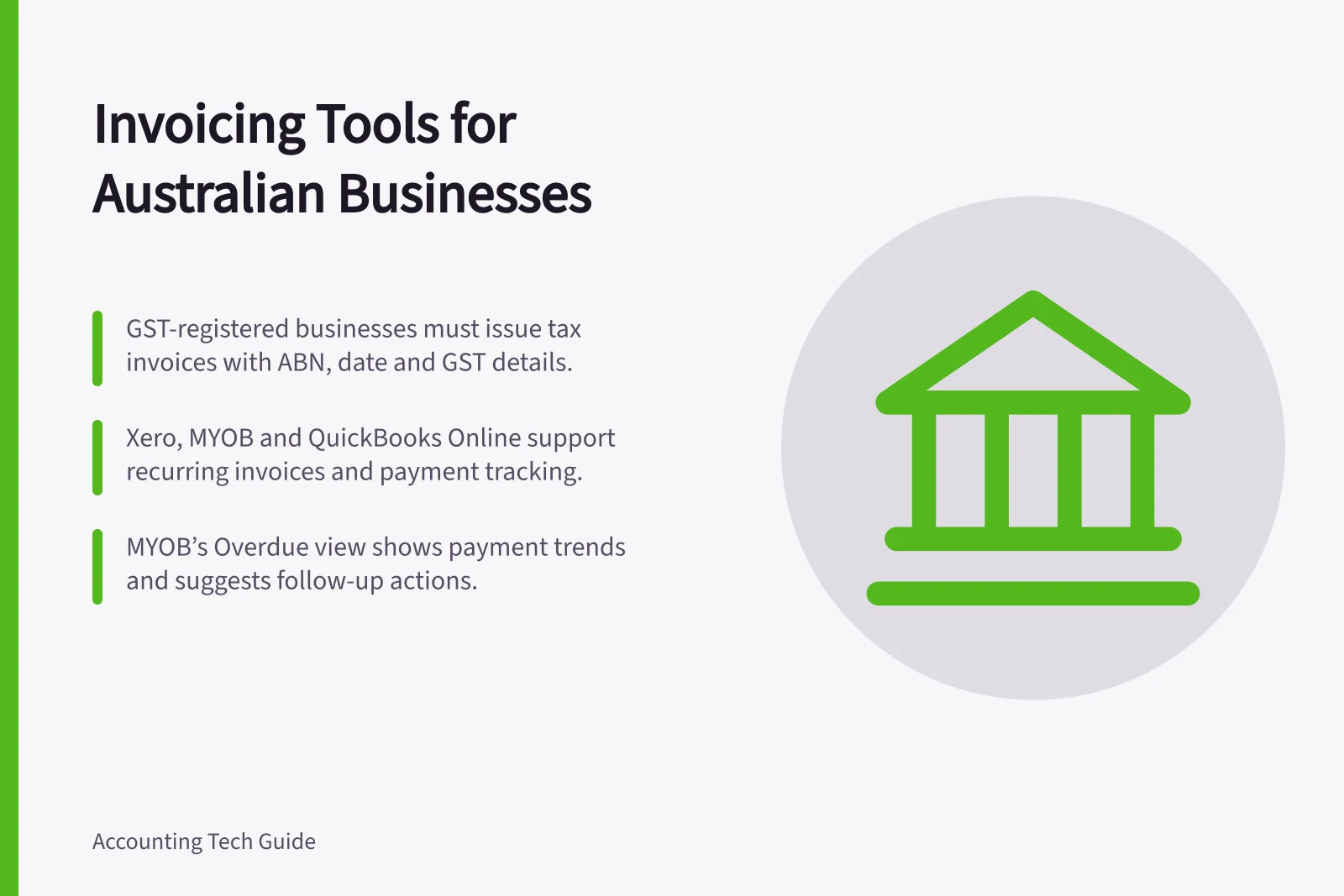
For GST-registered businesses, business.gov.au says a tax invoice is required for a taxable sale over $82.50 including GST, or whenever a customer asks for one. If requested, it must be provided within 28 days. A buyer’s identity or ABN is also required on tax invoices for sales over $1,000.
A receipt can serve as the invoice in many retail or online sales where payment happens at the transaction. The Australian Taxation Office allows recipient-created tax invoices only in certain industries or business setups, so confirm eligibility before building that process into a tool.
Check what happens after sending
Look for a receivables view that distinguishes drafts, issued invoices, partial payments and amounts paid in full. An invoice can be both overdue and disputed: the unpaid balance remains visible while someone investigates the customer's query. Check how staff record the reason, owner, next action and correspondence if the product has no dedicated dispute status.
Ask each supplier to demonstrate a partial receipt and a correction linked to the original invoice. Check how a bank movement is associated with the existing customer balance. Detailed bank matching and reconciliation belong in a separate review.
Reminder rules also need an exception path. Establish how staff pause or adjust routine follow-up for a dispute or an agreed payment arrangement. A due-date rule cannot interpret an unrecorded customer conversation.
Key invoicing statistics for Australian small businesses
- $82.50GST threshold for tax invoices
- $1,000ABN requirement on tax invoices
- 28daysTax invoice response time
Set terms and escalation steps
Payment terms form part of the sales contract. State accepted payment methods, when payment is due, any credit conditions and how overdue amounts will be followed up; business.gov.au gives 7, 14, 21 and 31 days as examples of credit periods.
For customers offered credit, consider checking credit before approval and setting a limit. If terms are uncertain, business.gov.au suggests seeking advice from an industry association or business adviser.
A practical collection sequence can start with a polite phone call or email reminder. If payment still does not arrive, options include a letter of demand or a debt collecting service; in some cases, a business may decide to stop chasing and write off the debt. Choose a tool that makes the next step and its owner visible.
Payment collection escalation steps for overdue invoices
- Day 1–7: Initial reminderSend polite email or SMS reminder.
- Day 8–14: Follow-up callContact customer directly to discuss payment delay.
- Day 15–30: Letter of demandIssue formal letter outlining overdue amount and consequences.
- After 30 days: Debt collection or write-offEngage a debt collector or formally write off the debt if uncollectible.
Compare a bounded shortlist
Use the same billing cases in the exact plan under consideration.
Xero. Xero describes repeating invoices, payment options and reminders. Check how the proposed setup handles disputed invoices.
MYOB Business. MYOB documents an Overdue view and separate invoice status and delivery activity. Its plan comparison lists unlimited quotes and invoices and distinguishes mobile-only Solo from browser-access Lite and Pro. Check the product variant and the available way to record a dispute.
QuickBooks Online. Intuit's Australian plan page lists invoicing across Simple Start, Essentials, Plus and Advanced, while recurring transactions start at Essentials. Its help describes recurring transaction templates, including scheduled or reminder types, and says recurring invoices are saved as drafts for review and finalisation. Confirm the actual approval and send sequence in the intended account before relying on unattended billing.
Check follow-up cues in provider views
MYOB’s Overdue view can suggest Send email, Send reminder, Contact customer or Watch and wait. The suggestions depend on invoice status, reminder settings and recent activity, giving staff a cue to avoid extra chasing when a scheduled reminder has recently been sent or is due soon.
MYOB also shows how many days a customer typically takes to pay after invoicing. This can help staff decide where to focus follow-up, but it does not replace checking the specific invoice’s status and activity.
Compare payment options
When comparing invoice payment options, check both the methods available to customers and any extra setup involved. Xero lists card, direct debit, PayTo and Zip payments from online invoices, and says GoCardless can collect recurring invoice payments by direct debit on the due date.
Xero also describes sending invoices by SMS and adding a Pay now button. Ask whether the options suit your customers and whether online payment fees apply to the plan you are considering.
Make the decision
Give each candidate the same fictional customer, terms, partial payment, query and correction. Have a reviewer locate the remaining balance, invoice history and next action. Record each gap as a plan limit, configuration task, manual step or open question.
Assign an owner to review exceptions before enabling reminders or repeat billing. Decide how invoices and supporting records will remain accessible. Choose a tool that shows unpaid balances, invoice activity and the next follow-up action in the plan you intend to use.
Review checklist for invoice management readiness
- Can the tool track unpaid balances?Yes – ensure it distinguishes drafts, issued, partial, and paid invoices.
- Does it support dispute tracking?Yes – verify if it allows recording reasons, owners, and next actions.
- Is there a visible next action cue?Yes – e.g., MYOB’s Overdue view suggests Send email, Contact customer, etc.
- Are recurring invoices configurable?Yes – check approval and send sequence before enabling auto-billing.
- Can historical records be retained?Yes – confirm long-term accessibility of invoices and corrections.
In this guide
- Choosing invoice fields from business and local requirementsBuild an Australian invoice template around required tax invoice details, customer references and clear payment instructions.
- Tracking issued, overdue and disputed invoices separatelyUse separate balance and follow-up views to manage overdue, partly paid and disputed customer invoices.
- Testing recurring invoices before enabling automationCheck recurring invoice templates, schedules, sending, changes and duplicate risks before turning on automated billing.