Migration
Part of Accounting data migration
Mapping historical data into a new accounting system
Create a field crosswalk for historical accounting records and check dates, references, relationships and balances after import.
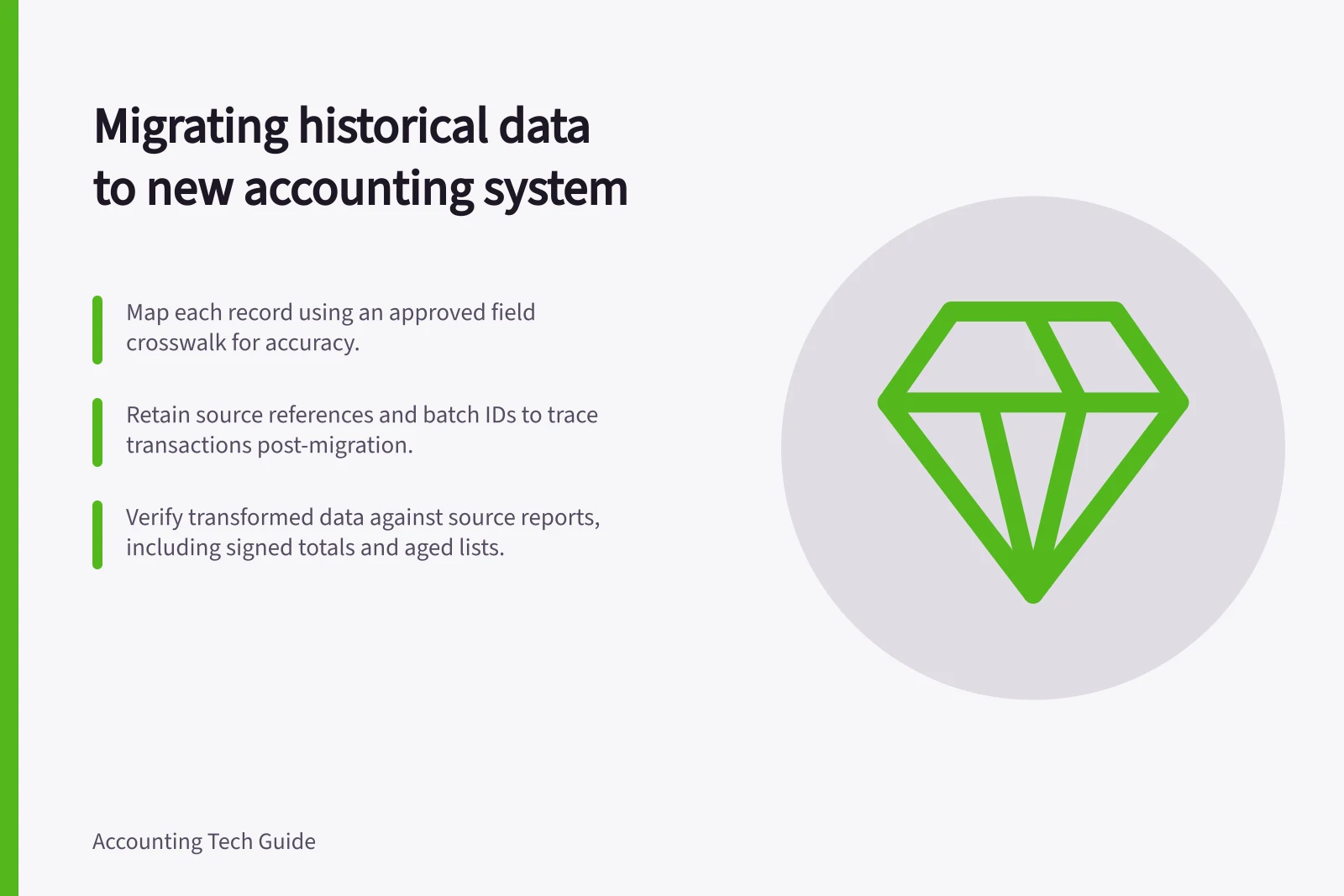
Map each historical record by defining its destination type, fields and surviving source reference. Account codes matter, but a transaction can still be wrong if its date, contact, status or payment link is lost. Use an approved field crosswalk for each record type.
Define the history that will move
State whether the destination will hold detailed past transactions, comparative balances or only open items at changeover. A comparative balance can support a report without making earlier invoices searchable. An unpaid invoice needs enough detail to receive a later payment; a closed invoice may remain in the source archive.
Some records may remain in the previous system or in reports. Unpaid invoices may need manual entry. Closed sales and bills that cannot be brought across should stay in the source system for record keeping.
Check the supported record types, fields and conversion service proposed for the business.
Build a field crosswalk
For each source type, specify the destination type, required fields and any transformation. Keep source and destination identifiers, including a batch reference where available.
| Field | Mapping question |
|---|---|
| Entity and contact | Does the record belong to the right business and customer or supplier? |
| Dates | Which date sets the accounting period, and which dates describe the document or payment? |
| Reference | Can the original invoice, bill, journal or source event still be found? |
| Amount and sign | Are credits, refunds and reversals represented in the intended direction? |
| Account and GST code | Has the treatment been approved for this transaction? |
| Status and links | Is the item open, paid, credited or reversed, and which records explain that state? |
Use the separately approved account crosswalk rather than redesigning the chart here. A source account name cannot, by itself, settle a GST code or show whether a bank receipt pays an existing invoice.
Handle relationships and exclusions
Map an invoice with its receipt and a bill with its payment. If the sale or purchase is already recorded, a payment must not become another sale or expense.
For an item unpaid at changeover, compare the remaining amount with the aged list and control balance. Check credits and part payments separately, especially when the original invoice falls outside the import range.
For a summary balance, retain the underlying detailed report and its period. If the destination cannot carry a source relationship or field, mark it as archive-only and document how it can be retrieved.
Ask an accountant or BAS adviser to decide uncertain timing or GST treatment instead of relying on a default import code.
Check the transformed result
Compare source and transformed records by entity, type, period, count and signed total. Inspect duplicates, blank required fields, credits and dates around the cut-off. Preserve the untouched export, mapping version and rejected-row list.
After loading, compare destination detail and balances with the agreed source reports. A balanced trial balance does not prove that customers, suppliers or references were assigned correctly.
Approve the crosswalk when a reviewer can trace a destination record to its source and explain any intentional loss of detail.
Critical Data Integrity Metrics to Verify Post-Import
- Record Count Match
- Source vs. destination count comparison
- Signed Total Accuracy
- Agreed trial balance validation
- Reference Traceability
- All destination records linked to source IDs
- GST Treatment Consistency
- Confirmed via BAS adviser or approved crosswalk