Migration
Part of Accounting data migration
Exporting transactions and supporting documents with links
Inventory and check accounting transaction files, reports and attachments so older records remain retrievable after migration.
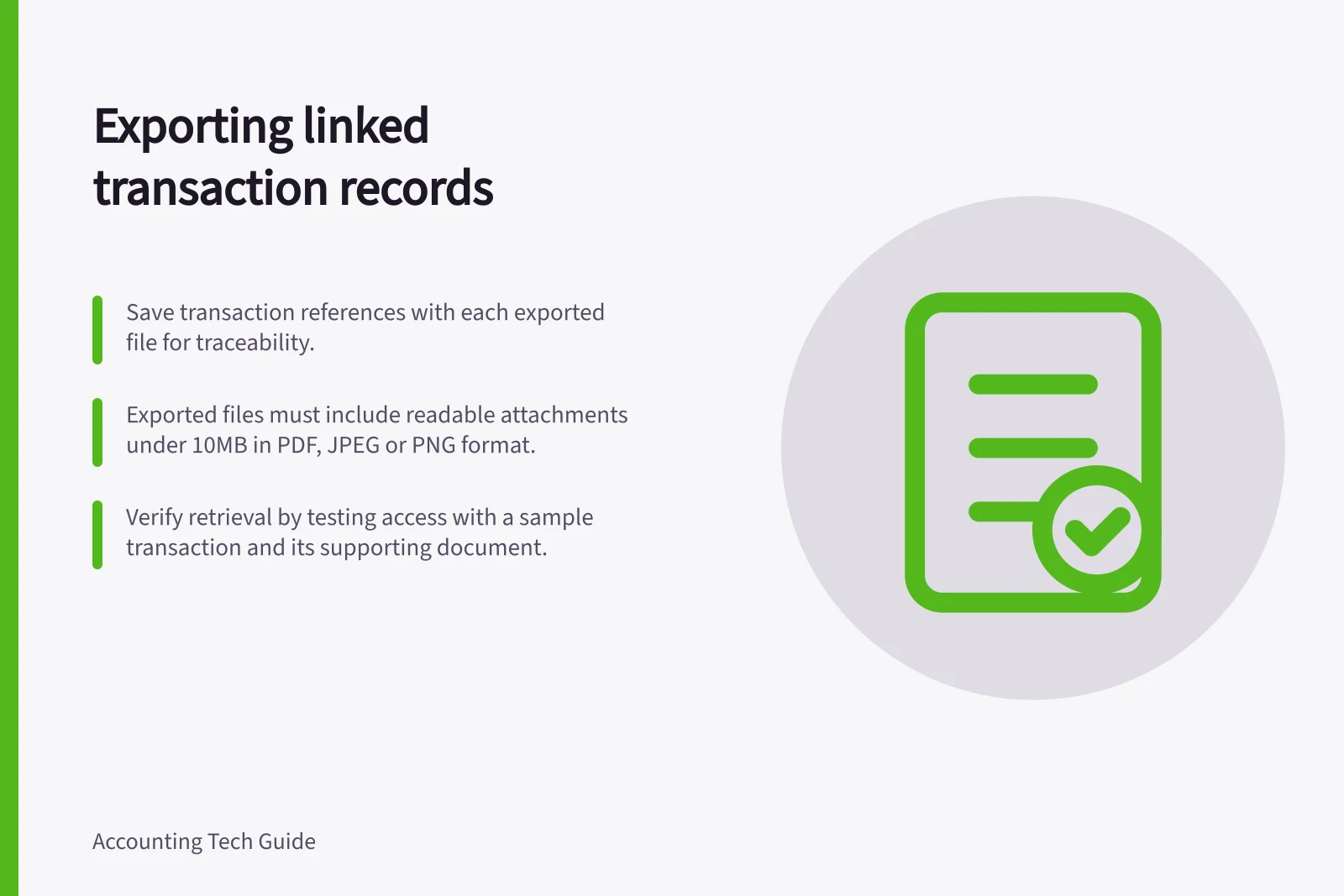
Export ledger transactions and their supporting documents as a linked record set: save each available file and record its transaction reference. Transaction data and attached files may be exported or saved separately, so check each output and test whether another person can retrieve a sampled entry and its evidence.
Inventory the source records
List the entities, periods and systems involved. For each record type, note the export route, expected date range, owner and archive location. Include transaction detail, contacts, open invoices and bills, bank reconciliations, relevant GST and payroll reports, and attachments; save report settings because a ledger filtered to one account is not complete.
| Collection | Check before accepting it |
|---|---|
| Transaction files | Entity, dates, transaction type, reference, account, amount and status. |
| Reports | Period, basis, filters, totals and preparation date. |
| Documents | Readable files and a way to connect them to source transactions. |
| Archive | Who can open the records after old-system access changes. |
The Australian Government's business.gov.au Record keeping guidance says businesses must keep records of transactions relating to tax, super and registrations, including sales, expenses, bank records and GST records where registered. It identifies the ATO's free record-keeping evaluation tool and says the ATO recommends digital records; store them to prevent change or damage, and back them up, with secure off-site storage if possible.
Most business records must be kept for five years from when they were prepared or obtained, or from when the related transaction or act was completed, whichever is later. Some exceptions may require longer retention.
Export and inspect each output
In MYOB AccountRight, the Import/Export Assistant exports each data type separately as tab-separated or comma-separated text. Export access requires an assigned role; Administrator and Accountant/Bookkeeper are default roles that provide access.
Open each resulting export or report. Check its dates, headings, record count, identifiers and signed totals against dated source reports. Keep an untouched original before preparing a transformed import file; a PDF can preserve a readable report when a structured file is needed.
For another product, check its own help for the export controls and any transaction-level attachment view or individual file-saving route. Confirm whether the transaction export retains the attachment link rather than assuming it does.
Preserve document links
AccountRight online company files support attachments on sales invoices, including time billing invoices, quotes and sales orders, purchase bills, spend money transactions and journal entries. To save an attachment, open its transaction, click Attachments, select the document, click Enlarge to display it in a browser, then use the browser's save icon and choose a location.
Supported attachment formats are PDF, TIFF, JPEG and PNG; files must be less than 10MB. To find attached transactions, use the Sales Register for sales, Purchases Register for bills, Bank Register for spend money transactions, or Transaction Journal for journal entries; an attachment icon identifies transactions with files.
Keep an attachment register keyed to a stable transaction reference or another agreed identifier. Record the file name, document type, source location, related invoice or bill, and whether the file opened; use the source reference and date to distinguish files with repeated names.
If another product cannot export the link between a transaction and its attachment, record the gap and retain an accessible old-system archive or a separately documented link.
Prove retrieval before access changes
Ask someone who did not prepare the archive to find a sampled transaction, its supporting document and its effect in a dated report. Include an open item, a corrected item and an older period. Record missing files and owners.
Check secure storage, backups and the access needed to read the records before changing the old subscription or file access.