Migration
Accounting software costs and contracts
Compare Australian accounting software costs, plan limits, setup work, billing terms and access to records after cancellation.
Compare the cost of running your actual work for a full year. Include the normal subscription charge, usage and add-on fees, setup, conversion and the work needed to retrieve records if you leave. Before subscribing, confirm the plan limits, billing cycle and cancellation terms in the proposed agreement.
Build a comparable annual budget
Record your busiest month of invoices and bills, the people who need access, the bank accounts and employees involved, and each business file you need. Use the same workload and period for every quote.
| Cost | What to confirm |
|---|---|
| Subscription | Normal charge after an offer, billing cycle and GST treatment shown in the quote. |
| Limits | The fee or plan change required when activity exceeds an allowance. |
| Extra functions | Payroll, expenses, payments, inventory and connected apps needed for named tasks. |
| Setup and conversion | Configuration, training, historical records, attachments and review work. |
| Exit | The time and any service cost needed to export and retain usable records. |
A seasonal business should check monthly limits against its peak. Ask when it can move back to a lower tier.
Put each offer’s introductory rate and subsequent rate on separate lines, then apply each to the relevant part of your comparison period. Include any usage charges that would arise from the workload you recorded, rather than treating the advertised base price as the complete cost.
Ask the provider to identify which rates, fees and billing cycle will appear in the agreement, and when a promotional rate ends. QuickBooks advertises 70% off for 6 months; ask for the standard price before comparing plans.
Treat the figures below as subscription totals, not a complete annual operating cost. Check separately for GST treatment, usage, add-ons, setup, training, conversion and any adviser or exit costs.
Xero says its customer support is free and unlimited, available 24/7. For onsite setup assistance, it recommends using an accountant or bookkeeper listed in its advisor directory; confirm any separate professional fee directly with the adviser.
Check the limits behind the price
Plan limits and included features vary by provider and tier, and can affect the annual cost. Check the applicable plan details against your expected activity.
Xero Ignite lists 20 invoices, 5 bills and payroll for 1 person; Grow lists invoices and bills as included and payroll for 2 people. Xero also lists $5 per month for each additional expenses user on Grow, $0.35 per bill payment in specified cases and $8 per month for Ignite auto-reconciliation. Check the current plan details for the allowance that applies to your workload.
MYOB Lite is for businesses with up to 2 employees, and MYOB lists payroll at an extra $3 per month per employee. MYOB Pro lists payroll for unlimited employees at an extra $3 per month per employee; price any required payroll separately.
QuickBooks names Simple Start, Essentials, Plus and Advanced, with 1, 3, 5 and 25 users respectively, plus accountant access. Price the applicable plan and any required extras before treating it as comparable.
Price each business file too. MYOB says each MYOB Business file needs its own subscription.
Key Plan Limits and Add-On Costs for Australian Accounting Software
- Xero Ignite: Invoices included
- 20 invoices/month
- Xero Grow: Bills included
- Unlimited bills
- Xero Grow: Payroll
- For 2 employees
- Xero: Additional expenses user
- $5/month per user
- MYOB Lite: Employees
- Up to 2
- MYOB Pro: Payroll
- $3/month per employee
- QuickBooks: Users
- 1 (Simple Start) to 25 (Advanced)
Separate introductory offers from ongoing costs
For the first 12 months, Xero’s displayed rates work out to $355.20 for Ignite ($7.40 for 3 months, then $37 for 9 months). Grow works out to $748.80 ($15.60 for 3 months, then $78 for 9 months).
Xero’s displayed Comprehensive rate is $21.40 per month for 3 months, then $107 per month; that is $1,027.20 for the first 12 months. Ultimate 10 is $28.60 per month for 3 months, then $143 per month; that is $1,372.80 for the first 12 months.
MYOB lists Solo at $12 for the first 12 months and $99 per year after the offer period. Lite is $94.50 per year during the offer and $315 per year after it. Pro works out to $546 for the first 12 months ($21 per month for 6 months, then $70 per month for 6 months). These calculations use the displayed rates and exclude usage charges and other extras.
MYOB AccountRight Plus is displayed at $66 per month for the first 3 months, then $165 per month. At those rates, the first 12 months total $1,683, before usage charges and other extras.
QuickBooks advertises 70% off for 6 months, but its stated pricing does not give a dollar rate or billing option. A 12-month total cannot be calculated without the standard rate and billing option; ask QuickBooks for both.
Pros and Cons of Introductory Offers vs Ongoing Costs
- ProsLower initial cost; ideal for testing software; budget-friendly entry point
- ConsRate increase after promotional period; potential for higher long-term costs; unclear billing terms without confirmation
Compare the contract and exit route
Before signing, check the terms for the specific option offered to you, including cancellation notice, renewal, refunds and the next billing date.
The stated plan details do not specify contract length or minimum commitment, cancellation notice, refund rules, auto-renewal, price-increase terms, cancellation fees, data-export charges or the next billing date for Xero, MYOB or QuickBooks. Check the agreement for each item, including the notice deadline and any amount due when you leave.
MYOB says cancelling a business requires cancelling its associated subscription. Its guidance does not state a cancellation notice period or refund rule, so confirm those in the agreement for the subscription you are considering.
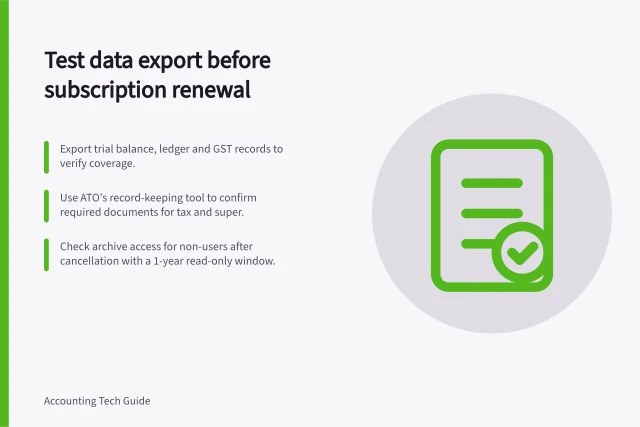
Before renewal or cancellation, identify the reports, transactions and documents you can export, then open a representative sample. Australian businesses must retain relevant transaction records and keep digital records accessible and protected.
business.gov.au says records relating to tax, superannuation and registrations must be kept in English or be easily translated into English. Relevant records include income, expenses, bank records, GST records and employee and contractor records.
The Australian Government advises that digital records must be stored to prevent change or damage, with backups and access to the devices and passwords needed to retrieve them. If paper records are digitised, the Australian Taxation Office accepts images that are true and clear reproductions and follow record-keeping rules.
The ATO’s free record-keeping tool can help identify which records your business needs to keep. No retention-period figure is stated here, so check the period that applies to your records rather than assuming one applies to all records.
In this guide
- Checking data export before renewing a subscriptionCheck report, transaction and attachment retrieval before renewing or cancelling Australian accounting software.
- Evaluating paid add-ons against actual accounting tasksCompare paid payroll, expenses, inventory, payments and connected apps with the accounting work they must complete and their full cost.