GST & Reporting
Financial reporting software
Compare financial reporting software by checking report purpose, accounting basis, plan limits, traceability and export controls.
Start with the reports your business needs to produce, then check whether another person can explain their figures. A useful system shows the reporting period, accounting basis and included records clearly enough for a reviewer to reproduce the result.
A profit and loss statement covers performance over a period. A balance sheet shows balances at a date. A cash flow report describes cash movements. A cash-basis profit and loss is a different report from a cash flow statement, even though both concern cash.
Define the reports you need
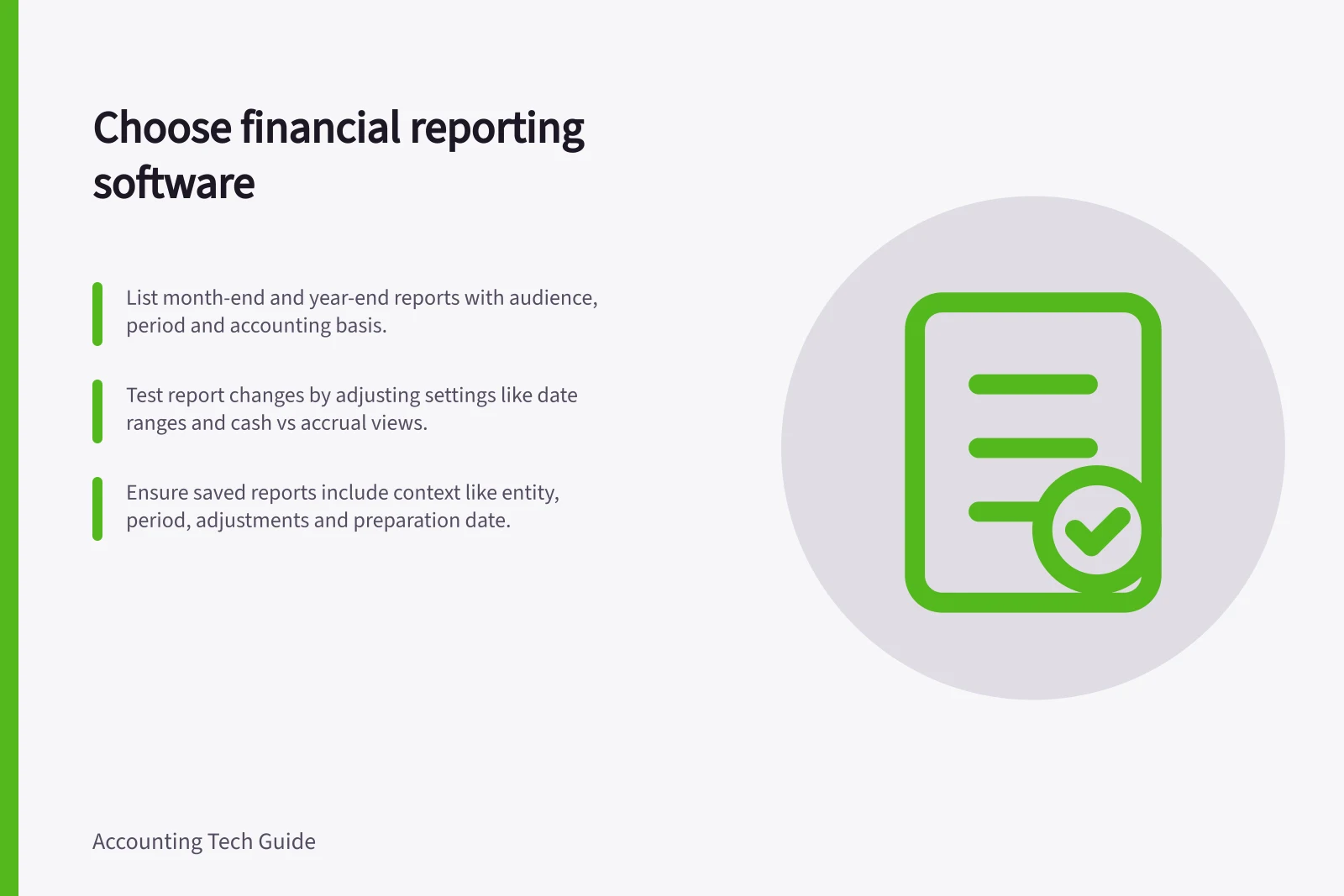
List the reports used at month end and year end. For each, record its audience, entity, period, accounting basis, level of detail and reviewer. Include budget or departmental comparisons only where they serve a real decision.
| Reporting need | What to check in a demonstration |
|---|---|
| Profit and loss | Are the period, basis, comparison and adjustments clear? |
| Balance sheet | Can balances be traced to the underlying accounts at the stated date? |
| Cash reporting | Is the output a cash movement report, a cash-basis profit and loss or a forecast? |
| Budget comparison | Are the budget version and account mapping clear? |
| Management pack | Can the team retain the reviewed copy and identify a later rerun? |
Report design cannot correct missing transactions, unreconciled accounts or wrong account mappings. Establish a close and review process alongside the software choice.
Include analysis outputs that help reviewers identify exceptions, not just standard statements. business.gov.au recommends reviewing financial documents regularly and looking for trends such as falling sales, low profit margins, spending above budget, existing debt and periods of unusually high or low cash flow.
If external comparison matters to a decision, establish whether the team needs benchmark context as well as internal comparisons. The Australian Taxation Office publishes small business benchmarks for comparison with similar businesses, while business.gov.au says its financial health check should be done at least once a year.
Assess analysis and comparison options
Check whether reports support the comparisons your decisions require, rather than judging a system by the number of report names in its menu. Xero describes interactive reports for measuring performance against KPIs, and tracking categories for comparing results across locations or departments.
For budget analysis, test whether the system compares estimated spending with actual amounts and makes the budget version clear. Xero describes formulas for comparing budgets and forecasts, while MYOB documents comparisons with budget targets or last year’s totals, including bar or line graph displays.
Consider whether reviewers need to adjust the presentation without changing the underlying report purpose. Xero lists options to add, remove and reorder rows and columns, use custom formulas, add notes and link to report schedules; test the specific functions your team would use.
Test the reporting path
In a demonstration, use one controlled period and entity. Run the required reports, then change one setting at a time to see which figures move. Ask how the system handles date ranges, comparison periods, cash and accrual views, account groups, tracking filters and year-end adjustments. Check whether a setting applies to the business, an individual user or one report.
Ask the presenter to show how an unpaid customer invoice, an unpaid supplier bill and an approved adjustment appear. Have a second reviewer trace a total back to the ledger and confirm that the exported copy records enough context to interpret it.
Changing a management report's cash or accrual view does not, by itself, decide the business's bookkeeping policy or GST reporting basis. Confirm the appropriate basis for approved accounts and tax reporting separately.
Compare a bounded shortlist
Check the current Australian plan, report view and permissions you would use.
Xero. Its Australian reporting page describes profit and loss, balance sheet, cash flow and budget comparisons, with configurable layouts and tracking categories.
Xero describes comparing budgeted spending with actual amounts and reviewing profitability. Confirm that the reports and permissions you need are available in your proposed plan.
MYOB Business. MYOB documents profit and loss, balance sheet, cash movement and budget views. Its instructions describe adapting an existing report rather than creating one from scratch. Reports available depend on the plan; browser and AccountRight desktop instructions also differ. Check the required report, adjustment setting and export in the product variant you would buy.
QuickBooks Online. Intuit's Australian report list shows profit and loss and balance sheet across its listed plans, a custom summary report from Plus, and enhanced custom report creation in Advanced. The list shows the statement of cash flows is unavailable on Simple Start and available on Essentials, Plus and Advanced.
Intuit also documents cash and accrual controls for individual reports, with different steps in Classic and Modern views.
For a separate viability check, the ATO provides a free business viability assessment tool that requires financial figures for at least 3 months and returns a report on finances and business viability. Treat this as an external assessment option, not as a reason to assume a shortlisted product includes the tool.
Comparison of financial reporting features across leading Australian accounting software
- XeroProfit and loss, balance sheet, cash flow, budget comparisons; configurable layouts and tracking categories; interactive reports for KPIs; custom formulas and notes; export to PDF, Excel
- MYOB BusinessProfit and loss, balance sheet, cash movement, budget views; adapt existing reports; save/share custom reports; PDF templates with headers, footers, watermarks; export to Excel
- QuickBooks OnlineProfit and loss, balance sheet (available on Essentials, Plus, Advanced); statement of cash flows (not in Simple Start); enhanced custom report creation in Advanced; cash/accrual controls per report; export options
Check saved outputs and access
A reporting workflow should make reviewed outputs repeatable and limit access to saved versions appropriately. MYOB lets users save a customised report and choose whether it is available only to them or to all users; its documentation also describes duplicating a custom report and editing its permissions.
If reports leave the system for review, check whether the format is fit for the audience and whether later changes can be managed. MYOB describes PDF templates with images, headers, footers and watermarks, and permits further report changes in Excel after export; decide whether those steps suit your review controls.
Preserve the approved result
Before sharing a pack, record its entity, period, basis, filters, account mapping, adjustment choices, comparison definition and preparation date. Keep the reviewed copy and its reconciliation. If later entries change a live report, label the rerun as a new version.
In this guide
- Comparing cash and accrual views in a systemCompare cash and accrual reports using the same settings, trace timing differences and label each view before sharing figures.
- Checking report dates and inclusion rulesCheck period boundaries, accounting basis, filters, adjustments and comparison columns before relying on a financial report total.
- Reconciling management reports with approved accountsBuild a documented bridge from approved accounts to management figures, including mappings, excluded adjustments and open differences.
- Exporting a report with its filters and assumptionsPackage a financial report with its dates, basis, filters, adjustment settings and review status so recipients can interpret the export.